Waking Beauty Performance at Story Town 2008
Some more of the best of libraries!
I just watched this video of PCPL staff dramatizing the picture book Waking Beauty by Leah Wilcox from last weekend's Story Town, and I'm still chuckling!
The Waking Beauty Players:
Sleeping Beauty: Deanna (South Tucson Library)
Prince Charming: Aaron (El Pueblo Library)
Fairies: Thania (Valencia Library), Maya (Santa Rosa Library), and Fabiana
Narrator: Lupita (Mission Library)
Filmed by Steve Shull
Please do yourself a favor and watch this. You will have a good feeling inside all day.
P.S. The wind noise dies down fairly quickly.
Showing posts with label ChildrensLiterature. Show all posts
Showing posts with label ChildrensLiterature. Show all posts
Friday, November 21, 2008


Tuesday, September 30, 2008
Riikka's new book is out! In Finland (alas not U.S.)
 Well, on a cheerier note, my friend Riikka tells me her new book is out in Finland, the sequel to her first story, Nokikätkön ritarit ja Kuuhiisi, or The Knights of the Sooty Nook and the Moon Troll. The new book's title is Vaahteratuvan väki ja vaarallinen peto, I have no idea what that is in English. Yet. Riikka tells me that a copy is on its way.
So, to celebrate I scanned the picture she drew of Arrow when she was here last March.
A plot summary and list of chapters for Riikka's first book can be read here.
UPDATE: I posted about Riikka's new book on my other blog by mistake! Here's the link: madam-pince.blogspot.com/2009/06/on-mood-wolves-and-drawing.html
Wednesday, July 16, 2008
A Must-Read Article in the New Yorker
I just finished reading "The Lion and the Mouse: The battle that reshaped children’s literature" by Jill Lepore, from the July 21 issue of The New Yorker. I heartily recommend it to anyone who loves children's books.
Lepore's account of the appalling history of early children's services alone makes the article worth reading, but from there it goes on to report on the conflict between Anne Campbell Moore, NYPL's influential children's librarian and the author E.B. White. When you evaluate a new children's book, are you a Miss Moore, or an Ursula Nordstrom?
The article make me wonder: When did I form my ideas about what makes a good children's book, and how to recommend them to others? Was it when I was in the 5th grade and learned that my grandmother (a former teacher who graduated c. 1914) had thrown out all 44 copies of the Nancy Drew series that I had devoured the previous summer? Was it when I was in the 6th grade and listened in frustration to a salesperson at the old El Con Bookstore flounder about when asked for a good book for a 12-year-old? (It was my first reference question, and I talked him into The Mixed-Up Files of Mrs. Basil E. Frankweiler.)
At any rate, I really enjoyed this article because it made me think about and remember why we do what we do.
I need to read Stuart Little again.
Lepore's account of the appalling history of early children's services alone makes the article worth reading, but from there it goes on to report on the conflict between Anne Campbell Moore, NYPL's influential children's librarian and the author E.B. White. When you evaluate a new children's book, are you a Miss Moore, or an Ursula Nordstrom?
The article make me wonder: When did I form my ideas about what makes a good children's book, and how to recommend them to others? Was it when I was in the 5th grade and learned that my grandmother (a former teacher who graduated c. 1914) had thrown out all 44 copies of the Nancy Drew series that I had devoured the previous summer? Was it when I was in the 6th grade and listened in frustration to a salesperson at the old El Con Bookstore flounder about when asked for a good book for a 12-year-old? (It was my first reference question, and I talked him into The Mixed-Up Files of Mrs. Basil E. Frankweiler.)
At any rate, I really enjoyed this article because it made me think about and remember why we do what we do.
I need to read Stuart Little again.
Wednesday, July 02, 2008

Saturday, March 29, 2008
A visit from Riikka Jäntti
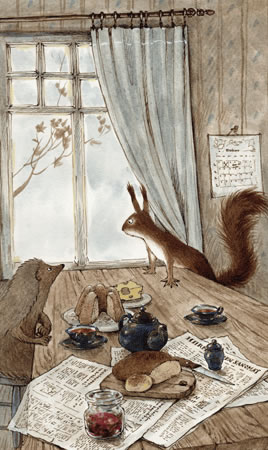 Last week we had a visit from Finnish author and illustrator Riikka Jäntti. Riikka is the author of Nokikätkön ritarit ja Kuuhiisi, or The Knights of the Sooty Nook and the Moon Troll, a fantasy story where a squirrel named Chip and her friends Toivo the hedgehog and Iris the mouse save the world. Well their little corner of it. The friends discover that greedy thugs are planning on stealing a hidden crown that protects their village, and form a secret society called the Knights of the Sooty Nook to stop them.
While she was here we made an English summary of her story (two more are planned in Finland, the second one will be published shortly), and here is the list of chapters. It makes you want to read it, eh? I really hope she can get it published in the U.S. and U.K.!
Chapter One, In Which Chip the Squirrel and Toivo the Hedgehog make a new friend.
Chapter Two, In Which the Secret Society is Founded
Chapter Three, In Which Big Brother has Guests
Chapter Four, In Which they go Berry-picking at Ratham Manor
Chapter Five, In Which We Hear the Legend of Mouse Hill
Chapter Six, In Which Everyone Disappears
Chapter Seven, In Which Lord Ratham Speaks
Chapter Eight, In Which Big Brother has Second Thoughts
Chapter Nine, In Which it is Nearly Autumn
 I was able to show her Tucson at its most glorious. The weather was in the 80s, the sun shone every day, and the wildflowers were blooming all over the place. Riikka is spending a month traveling around America and recording her experiences in a delightful sketchbook journal.
Here are more images from her book:


Saturday, February 09, 2008
Our Motheread program at the Jail
 I have been co-teaching Motheread with Frederica Torres at the Pima County Adult Detention Center for nearly 6 months now and I love this program the more I do it.
A typical class starts with a get-to-know-you period. We encourage the women (and men, we do Fatheread classes too at the Jail) to come to all 8 sessions, but often there are new faces as the prisoner's situations are pretty fluid. So we start by asking everyone to tell the group their name and their kids' names. Most of the women are moms, but some are also aunts, sisters and grandmothers. Sometimes this is an emotional time as the women remember the children they are separated from. Some of the women have college degrees, but most never finished high school.
Then we pass the week's storybook out. Even though we're working with adults, Motheread uses children's picture books -- and it really works well. Then we read together. Everyone who wants to read aloud takes turn reading a page, until we're done. When we're through, we discuss our impressions of the story and its illustrations. Often the women will notice things I didn't observe, even after careful reading. Did you notice that the troll under the bridge in Paul Galdone's Three Billy Goats Gruff was chained to the bridge? The Troll didn't choose to be there, under the bridge threatening passersby, he was chained there.
The books are chosen carefully to be ones that work on many different levels and have messages of family, community, compassion and decision-making. Some of the titles we've used are The Runaway Bunny, Cherries and Cherry Pits, A Chair for My Mother, Grandfather's Journey, In My Family, The Tale of Rabbit and Coyote, and Abiyoyo.
The middle part of the class focuses on how the women can use the book with their children. We share storytelling tips and information about early literacy and child brain development, with an emphasis on the six skills of early literacy.
 The last part of the class is a writing project of some sort. For example, the week we read from Carmen Lomas Garza's book In My Family, we wrote about a food memory. When we read Sandra Cisneros' Hairs/Pellitos, everyone drew a self-portrait and wrote a descriptive paragraph about their hair. When I get back to the library I type their stories up, decorate them, and print them in color.
After the class is finished the women have a short crafts time. Typically we will bring die-cuts and colored paper, and the women will make stationary for their kids, cards, or write letters. We are prepared with large envelopes, and the book we read in class, the die-cut crafts and the writing assignment from the week before that I have decorated. These envelopes are checked for content and mailed to their children.
The last class is very special. We bring a digital recorder and record the women reading aloud to their children, and we send that on a CD in the last packet.
For the women (and the fathers in Fatheread), the classes are an escape of sorts and a chance for positive contact with their children. For Frederica, Ella, Dawn and I, we hope we've weakened the cycle of illiteracy and crime just a little bit. It feels very good.
There is more information on Motheread at the official website. Our program is funded by the Pima County Public Library and the Pima County Child Abuse Prevention Council.
Wednesday, February 14, 2007
Cybils Awards Announced!
 The Cybils Awards for 2006 have been announced! This is a wonderful list! Kudos to everyone involved!
From their press release:
The awards cap five months of activity by roughly 80 volunteers, who plowed through 482 books nominated by the public at the Cybils blog, www.cybils.com . The contest grew out of a comment on a blog post last October and rapidly gained traction in the tight-knit community of librarians, teachers, homeschoolers, parents, authors and illustrators, dubbed the "kidlitosphere."The idea was to find books with literary merit that kids couldn't put down, striking a balance between the highbrow Newberys, for example, and the populist Quill awards.
Any children's or young adult title published in English in 2006 was eligible, and anyone could nominate a book.
Subscribe to:
Posts (Atom)